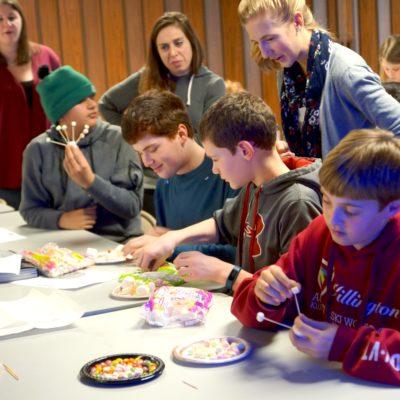
The science curriculum at MWJDS engages students in hands-on learning, utilizing experiments and observations to explore the natural world. MWJDS recognizes that the best way for students to appreciate the scientific process, learn important scientific concepts and develop the ability to think well is to construct ideas through investigations and analysis. Our inquiry-based approach enables students develop reasoning, decision-making and observation techniques while engaging in the process of experiment and discovery.
To enhance the learning process, MWJDS incorporates age-appropriate technology throughout the curriculum. Teachers employ cutting edge programs and websites to extending the children’s connections beyond the walls of MWJDS.

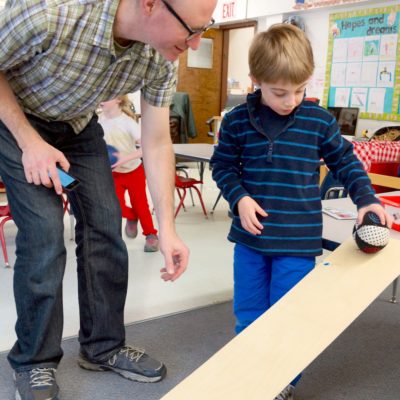
The Scientific Method
Students use the Scientific Method to learn important scientific concepts, and develop the ability to construct ideas through investigations and analysis. This inquiry-based approach enables students to develop their personal learning styles and problem-solving skills through guided exploration of specific topics as well as their individual ideas. They develop reasoning, decision-making, and observation techniques while engaging in unique experiences and discoveries.
Science Topics
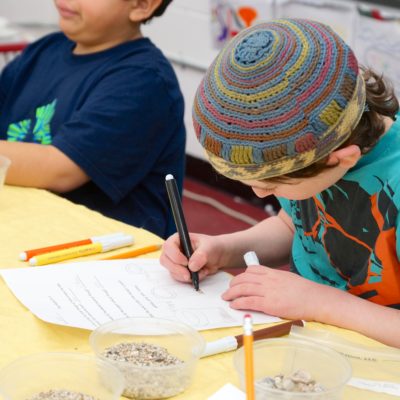
Each science unit covers a topic such as the human body, water, electricity, rocks and minerals, the physics of sound, solids and liquids, plants, insects, animals, air and weather. Manipulatives, experiments, and supplemental materials, as well as appropriate literature are used to complement each unit.
The 7-week rocketry project was led by 3 MIT scientists who engaged the 5th grade in a unit on the fundamentals of Newtonian Mechanics. The project as a whole provided students an understanding of Newton’s laws. First law: an object at rest stays at rest and an object in motion stays in motion. Second law: force equal the product of mass and acceleration. Third law: for every action, there is an equal and opposite reaction.
Computers and Technology
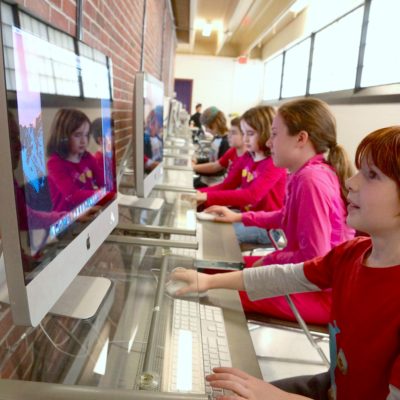
Computers are an integral part of the curriculum and are used as an educational enhancement to classroom instruction. Students are comfortable working on computers and use them to explore the internet for information, web-quests, geographic locations, publish stories, and play educational games.
University Partnerships
We are all fortunate in the Boston area to be part of such a rich university community. A former Head of School, RavHazzan Dr. Scott Sokol, had an active life as a research scientist and academic before moving into the field of Jewish education. As a result of his connections and those of our member families, MWJDS has fostered active partnerships with faculty at Brandeis University and Wellesley College especially in the sciences. Graduate students come to our school to demonstrate methods from their laboratories, and we visit university laboratories regularly to see scientific research in action.